
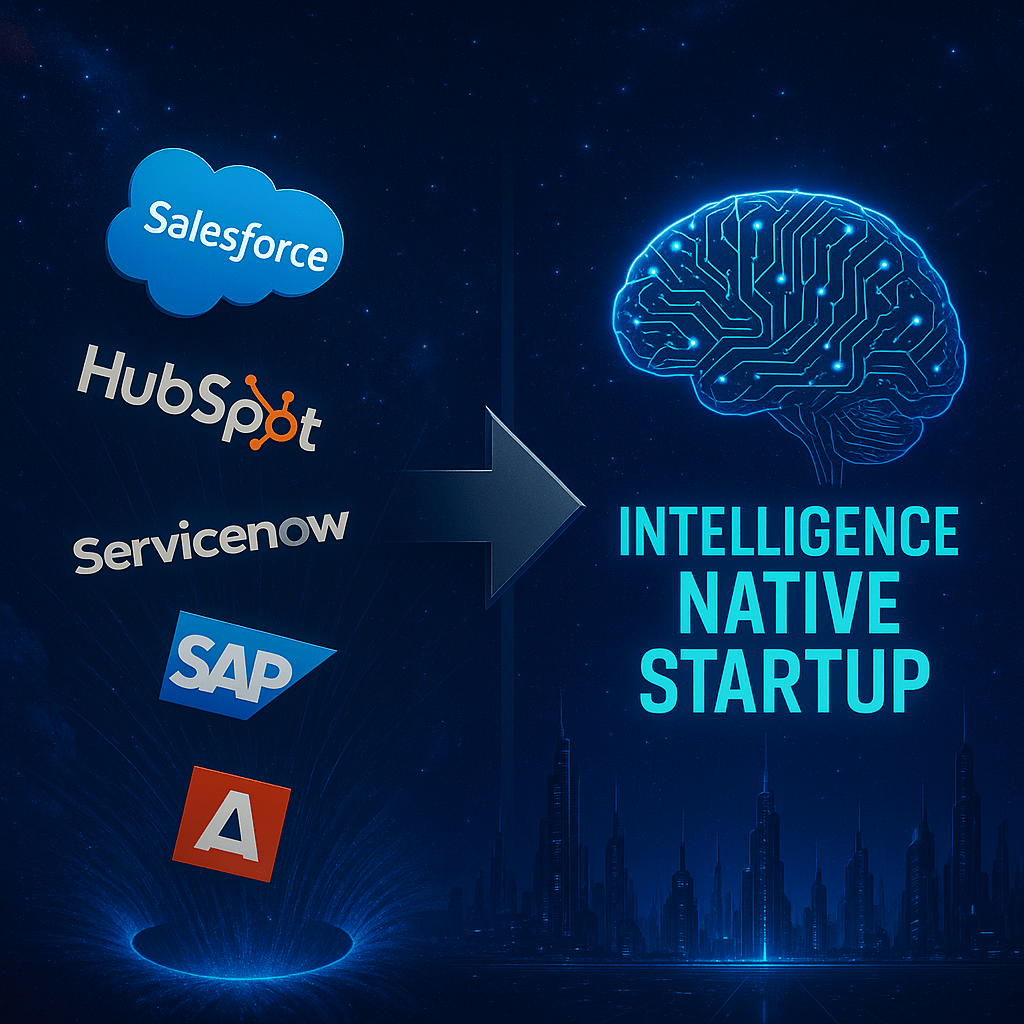
Last week, I wrote a post about how AI is eroding one of software’s most durable historical moats: switching costs. In an era where a foundation model can spin up a CRM or project management tool in minutes, the replication threat feels real and immediate.
But the deeper risk to incumbent software isn’t copycat products. It’s irrelevance.
The key question isn’t how easily software can be cloned—it’s whether the software being cloned is still what users want. Increasingly, the answer is no. We’re not just seeing a wave of imitation; we’re seeing a shift in user expectations. People don’t want cheaper software. They want intelligence.
This is the structural break in motion: the market is moving from deterministic systems to intelligent systems. From software that executes instructions to software that interprets, adapts, and collaborates.
To understand this shift, consider four levels of increasing software complexity:
- Basic workflow tools – Automate simple, repeatable tasks (e.g., to-do lists, spreadsheets)
- Complex workflow tools – Handle more intricate, rule-based processes (e.g., Docusign, Calendly)
- Enterprise systems – Encode operational logic and structured business rules at enterprise scale (e.g., Salesforce, SAP)
- Intelligent products – Learn from context, predict intent, and collaborate in real time (e.g., Cursor, Abridge, Gong)
The first three categories are deterministic: they follow predefined rules and logic trees. That’s why generative systems can now build them in hours—not quarters.
But category four is different. These products live on a new axis. They operate probabilistically. They don’t just follow rules—they evolve. They remember. They adapt. They make decisions under uncertainty, and they do it across vast user bases and contexts.
Building this kind of product isn’t “shipping an app.” It’s architecting a living system. One that combines:
- Persistent memory across sessions and users
- Tasteful generation and output shaping
- Accurate embedding stores and meaningful recall
- Latency-optimized AI pipelines
- A continuous mediation layer between model, software, and user
Take Cursor. It’s not just an IDE. It observes developer behavior, learns from patterns over time, and surfaces help before the user even asks. Its infrastructure is non-linear—it compounds. Every session makes it more valuable for the next. That’s not true of rule-based tools. In fact, the more rigid the incumbent system, the harder it is to retrofit this intelligence.
Which brings us to the core inversion now underway:
Incumbents aren’t being out-featured. They’re being out-learned.
While legacy players rush to ship AI features, intelligent-first startups are quietly compounding insight. Every user interaction tunes that specific product instance more uniquely. The result is a better experience and a stronger moat. It’s a fusion of inference loops, data flywheels, and UX design that—together—turn software into a personalized, adaptive system. The end state? A product that becomes an N-of-1 experience for every user.
In this context, initiatives like Chamath Palihapitiya’s “90:10” bet on low-cost software clones are thought-provoking, but dangerously backward-looking. They assume the value lies in replicating what worked before. But the expectation bar is rising—and intelligent systems will capture the surplus.
Ask yourself: how much would you pay today for a state-of-the-art black-and-white television? That’s what traditional software is becoming—functional, but fundamentally out of step with user expectations.
The future of software isn’t cheaper copies. It’s systems that understand you.
Let the learning race begin.
 Wandering Through the Noise
Leave a comment