
Every few years, venture capital flows back into college dorm rooms — and just as predictably, it retreats. Investors again dismiss inexperience as a fatal flaw. This rhythm isn’t random. It’s cyclical, mirroring the broader technology cycle itself.
Undergrad founders underperform most of the time, yet at the dawn of every new technological era, they capture an outsized share of value.
| Cycle / Era | Company | Founded | Market Cap / Value |
| PC (1975–1995) | Microsoft | 1975 | $3.75T |
| Social (2003–2012) | 2004 | $1.8T | |
| Crypto (2014–2021) | Ethereum | 2014 | $544B |
| Agentic AI (2022–Now) | Cursor / Mercor | 2022 | $30B+ (and rising) |
Across cycles, the same dynamic repeats: when the technological ground shifts, incumbency becomes a liability — and youth, a temporary edge.
Why Undergrads Win Early in the Cycle
Native to the New Paradigm: Undergrads learn the new paradigm first — and only the new. They don’t have to unlearn legacy systems or assumptions, giving them conceptual agility that older operators often lose.
No Established Social Proof: In the earliest innings, no one knows what’s credible. The 20-year-old power user can be as authoritative as a seasoned executive.
Curiosity Over Skepticism: Without professional scars or institutional framing, undergrads ask “why not?” before the world decides what’s realistic.
Low Social Risk, High Conviction: At the beginning of a new cycle, undergrads have the least social capital to lose by betting on an unproven technology. Their opportunity cost is low, their conviction high. Experienced operators, by contrast, face reputational risk in chasing something unvalidated.
Why the Window Closes
The undergrad advantage is real — but short-lived. Once a category matures, the basis of competition shifts.
Execution Replaces Discovery: After product–market fit emerges, the challenge moves from exploration to scale: hiring, distribution, regulation, and capital efficiency. Experience and networks — not intuition — now determine success.
Networks and Trust Reassert: As uncertainty falls, social capital rises. Funding, partnerships, and exits become governed by relationships and pattern-matching. The brief meritocracy of early cycles hardens back into hierarchy.
The Observation
Seed-stage venture capital follows the same cyclical logic — but always a step behind. Most investors grow interested in undergrad founders only after the first breakout success of a new era has already appeared. They respond to proof, not potential.
By the time the herd floods dorm rooms with capital, the undergrad window has already closed. The open field, lack of incumbency, and absence of “experts” — the very conditions that created those first winners — have disappeared. Investors end up funding imitators, not originators.
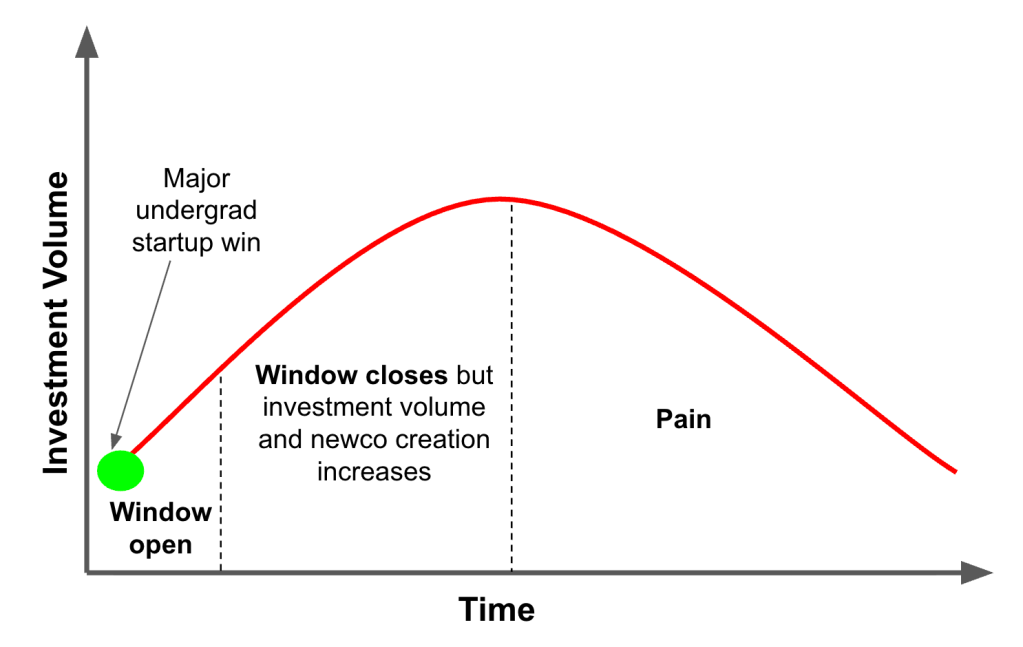
This timing error fuels the illusion that “undergrad startups don’t work.” In reality, it’s the investors who are mistimed.
The best undergrad bets are made before the pattern is visible, not after it’s been proven. Each generation of VCs forgets this — until the next cycle begins and the dorm lights flicker on again.
If You’re an Undergrad and the Window Feels Closed
Don’t worry — two paths are always open.
1. Start a New Cycle: The rarest but most powerful path is to ignite the next wave yourself. It requires vision, foresight, and a touch of luck — but it happens. Vitalik Buterin did it with Ethereum, cracking open the crypto era with smart contracts.
2. Out-Execute Everyone: The next best path is to simply outperform everyone else. It’s brutally hard — pure execution against all odds — but history shows it’s possible. Brex and Stripe didn’t ride a new cycle; they built so well that they became exceptions to it. When timing isn’t on your side, excellence still can be.
The undergrad advantage isn’t magical — it’s structural. At the start of every technology cycle, incumbents’ accumulated knowledge becomes a liability, while new entrants’ lack of baggage becomes an edge. As uncertainty falls, that dynamic reverses: experience compounds faster than curiosity.
The pattern is predictable, yet seed investors repeatedly mistime it, chasing proof instead of potential. The winners — both founders and backers — are the ones who act before the playbook exists.
 Wandering Through the Noise
Leave a comment