
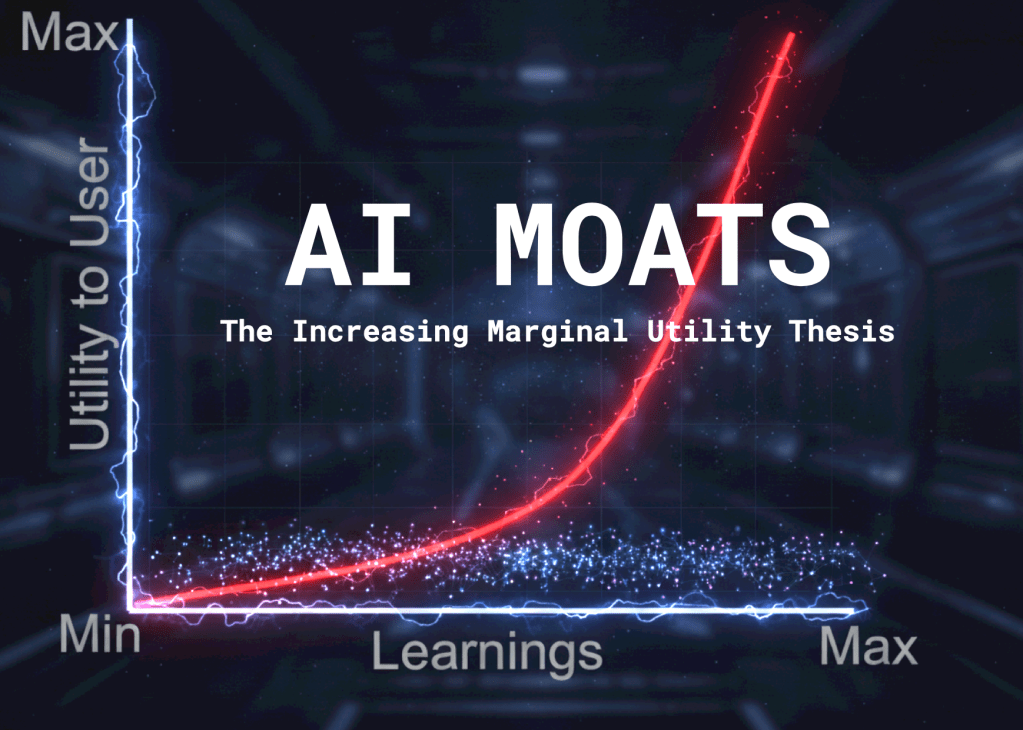
For the first time, it’s possible to create products whose value increases with each interaction.
Economists call it increasing marginal utility, but it has rarely taken meaningful form in software (or anywhere else for that matter). Traditional theory assumes diminishing returns: each additional use brings slightly less benefit. Increasing marginal utility flips that logic on its head. Here, every use increases the value.
We’ve seen hints of this idea before: Spotify learns your music tastes. Amazon remembers your credit card, and Google adjusts your search results. These are clever feedback loops, but none of them create enough utility to serve as a real moat.
In these examples, the learning is very front-loaded; once the system knows you reasonably well, the curve quickly flattens.
In a limited number of user engagements, a competitor could rapidly mirror a similar experience. This reality has been driven by the way that software is architected.

It has two main layers:
- The data layer, where user information and interactions are stored.
- The logic layer, the features, workflows, and automations of a software platform.
The data layer has always been dynamic, saving down user information with every click, but the logic layer has been largely static, changing only when engineers build new features.
The current wave of AI advances changes this. It allows the entire logic layer itself to become dynamic — capable of adapting, rewriting, and refining its own “rules” in response to experience.
When both the data and logic layers are dynamic, a new kind of software becomes possible. Intelligent systems that behave less like static tools and more like high-performing employees: learning and expanding their capacity to help.
One can envision an application watching usage each day and methodically proposing automation to take an increasing volume of work off the user’s plate.
This is where increasing marginal utility starts to feel possible. Instead of a value curve that flattens with use, we get one that steepens, each interaction enabling the system to be more valuable.

And that increasing utility may give rise to something rare, durable moats, and perhaps naturally increasing prices.
The beauty of this value capture model is that its moat is organically growing. The user can leave whenever they wish, but they will be leaving behind a trove of utility that was crafted just for them.
 Wandering Through the Noise
Leave a comment